
AI Infrastructure
Artificial Intelligence has evolved from a specialized area of computer science into a major technological capability used in healthcare, manufacturing, finance, education, transportation, defense, scientific research, and many other fields. Behind every successful AI application is a substantial collection of computing systems, data resources, software platforms, communication networks, and human expertise. Together, these resources constitute AI infrastructure. Just as roads, electrical grids, telecommunications networks, and factories provide infrastructure for an industrial economy, AI infrastructure provides the technological foundation for an increasingly AI-driven economy.
At the most fundamental level, AI infrastructure consists of the computing resources required to develop and operate AI models. Modern AI systems perform enormous numbers of mathematical calculations during training and inference. General-purpose CPUs can perform many of these calculations, but specialized processors such as Graphics Processing Units (GPUs) and other AI accelerators are particularly suitable for the parallel computations required by neural networks. Large AI systems may therefore use hundreds or thousands of processors working together. The availability, performance, and cost of these computing resources can significantly influence the capabilities of organizations developing AI.
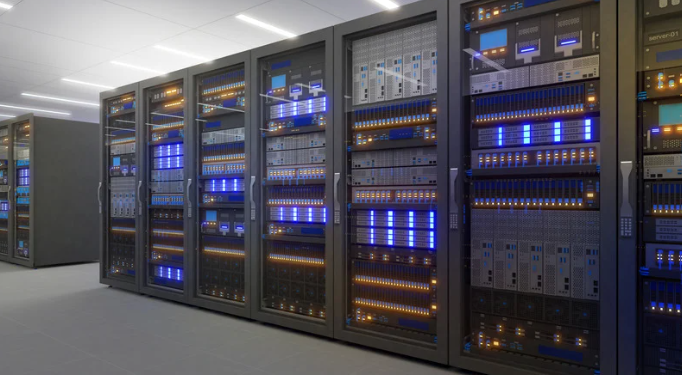
The physical foundation of large-scale AI infrastructure is the data center. A data center contains servers, processors, storage systems, networking equipment, power distribution systems, cooling equipment, security systems, and monitoring facilities. AI data centers may have considerably higher power densities than conventional enterprise data centers because large numbers of high-performance processors operate simultaneously. Consequently, designing an AI data center requires expertise in electrical engineering, computer engineering, thermal management, networking, reliability engineering, and facility management.
Electrical power has become a particularly important component of AI infrastructure. Large AI computing clusters require substantial and reliable electricity supplies. The electrical infrastructure may include utility connections, transformers, switchgear, uninterruptible power supplies, backup generators, batteries, and power-distribution equipment. As AI computing expands, access to economical and reliable electricity can influence where large AI data centers are constructed. Energy efficiency is therefore becoming an important consideration in both AI hardware design and data-center planning.
Closely associated with electricity is the problem of cooling. Processors convert a significant portion of the electrical energy they consume into heat. Excessive temperatures can reduce performance, damage equipment, or shorten component life. Traditional data centers have relied heavily on air cooling, but increasingly powerful AI processors have encouraged greater use of advanced cooling technologies, including direct-to-chip liquid cooling. The cooling infrastructure must continuously remove heat while maintaining appropriate operating conditions for expensive computing equipment.
Another essential component is high-speed networking. Training a large AI model frequently requires many processors to cooperate on the same computational task. These processors must exchange enormous quantities of information with very low delays. Consequently, AI clusters require high-bandwidth, low-latency communication networks. Network switches, optical communication systems, network interface controllers, cables, and specialized interconnection technologies become part of the AI computing architecture. At very large scales, network performance can determine how efficiently thousands of processors function as a coordinated computing system.
AI infrastructure also requires extensive data storage and data-management systems. AI models learn from data, which may include text, images, video, audio, scientific measurements, financial records, industrial sensor information, or other digital resources. Organizations therefore need systems for collecting, storing, organizing, retrieving, cleaning, protecting, and governing data. Large storage systems must deliver information rapidly enough to prevent expensive processors from remaining idle while waiting for data. Data quality is equally important because even enormous computing resources cannot compensate completely for inaccurate, incomplete, poorly organized, or inappropriate training data.
Above the hardware layer exists a substantial software infrastructure. AI developers use operating systems, programming languages, numerical libraries, machine-learning frameworks, databases, distributed computing platforms, development tools, and model-management systems. Software frameworks allow researchers and engineers to describe neural networks without individually programming millions or billions of mathematical operations. Additional software manages distributed training, schedules computing resources, monitors processor utilization, detects failures, stores checkpoints, evaluates models, and coordinates experiments.
Cloud computing has made AI infrastructure accessible to organizations that cannot construct their own large data centers. Through cloud-based AI infrastructure, universities, startups, corporations, and government laboratories can rent computing capacity when required rather than purchasing all the equipment themselves. This changes computing infrastructure from a predominantly capital investment into a resource that can also be purchased as a service. However, organizations must evaluate cost, data security, regulatory requirements, network dependence, and the possibility of becoming heavily dependent on a particular cloud ecosystem.
The infrastructure required for training AI models differs somewhat from the infrastructure required for AI inference. Training involves adjusting the internal parameters of a model using large datasets and may require enormous computational resources for days, weeks, or longer. Inference occurs after training, when the model processes new information and produces predictions, classifications, recommendations, images, text, or other outputs. Some inference takes place in large data centers, while other inference occurs on smartphones, automobiles, industrial machines, medical equipment, robots, or other edge devices. AI infrastructure therefore extends from enormous centralized computing facilities to small processors embedded in everyday products.
Cybersecurity and reliability are critical elements of this infrastructure. AI systems may process confidential business information, personal information, medical records, intellectual property, or strategically important government data. Infrastructure must therefore incorporate authentication, access control, encryption, network security, backup systems, intrusion detection, disaster recovery, and continuous monitoring. Hardware failures must also be anticipated. When thousands of processors and storage devices operate continuously, individual components will occasionally fail, making fault-tolerant system design essential.
AI infrastructure is not purely technological. It also requires extensive human infrastructure. Semiconductor engineers design processors; electrical engineers develop power systems; mechanical engineers design cooling systems; network engineers construct high-speed communication networks; software engineers develop platforms; data engineers organize information; AI researchers develop algorithms; cybersecurity specialists protect systems; and technicians operate and maintain data centers. Economists, managers, lawyers, policymakers, and regulatory specialists also contribute to decisions concerning investment, intellectual property, privacy, safety, and governance. The growth of AI consequently creates employment far beyond the occupation of AI researcher alone.
A broader view reveals an extensive AI supply chain. Semiconductor fabrication plants manufacture advanced chips. Other companies manufacture servers, memory devices, storage equipment, networking systems, transformers, cooling equipment, cables, and power systems. Construction companies build data centers, electrical utilities supply energy, telecommunications companies provide connectivity, and software companies provide development platforms. Universities educate scientists and engineers, while research laboratories develop new technologies. AI infrastructure is therefore an industrial ecosystem rather than a single technology.
This infrastructure also has important economic and geopolitical implications. Countries possessing advanced semiconductor manufacturing, abundant computing capacity, reliable electricity, sophisticated telecommunications, strong universities, research laboratories, investment capital, and highly trained professionals may have significant advantages in developing and deploying AI. Countries lacking these resources may become dependent on foreign computing platforms and technologies. For this reason, governments increasingly view computing capacity, semiconductor technology, data centers, energy infrastructure, and AI education as components of national technological capability.
The enormous investment required for advanced AI creates another important economic issue: access to computing resources. Large technology companies can invest billions of dollars in processors and data centers, whereas universities, small businesses, and individual researchers usually cannot. Shared national computing facilities, university supercomputing centers, cloud credits, public research infrastructure, and regional AI centers can help broaden access. Such facilities can play a role similar to shared scientific laboratories, allowing many institutions to use expensive infrastructure that would be uneconomical for each institution to purchase independently.
Environmental considerations are also becoming increasingly important. AI infrastructure consumes electricity, water, semiconductor materials, construction materials, and other physical resources. The environmental impact depends on factors such as processor efficiency, utilization rates, cooling technology, electricity generation, facility location, and equipment life cycles. Improvements in algorithms can also reduce infrastructure requirements by achieving comparable results with fewer computations. Sustainable AI development therefore requires simultaneous advances in hardware efficiency, software efficiency, data-center engineering, and energy systems.
AI infrastructure should ultimately be understood as a layered technological ecosystem. At the physical level are land, buildings, electricity, cooling systems, processors, storage devices, and communication networks. Above them are operating systems, AI frameworks, databases, cloud platforms, and cybersecurity systems. Above the software infrastructure are AI models and applications. Supporting every layer are universities, industries, skilled professionals, financial institutions, governments, standards organizations, and regulatory systems. Weakness in any major layer can restrict the development of the layers above it.
The development of AI therefore involves much more than designing better algorithms. A powerful algorithm has limited economic value without processors on which to execute it, data from which it can learn, electricity to power the processors, cooling systems to remove heat, networks to connect computers, software to coordinate operations, and skilled people to design and maintain the entire system. AI infrastructure is the bridge that transforms advances in artificial intelligence from scientific ideas into practical technological and economic capabilities. As AI becomes embedded throughout society, the strength, accessibility, reliability, efficiency, and security of this infrastructure will increasingly influence the technological competitiveness of companies, universities, industries, and nations.